Rules
Core Mechanic
Target number = Attribute + Difficulty.
Difficulty is a number from 0-10, set by the GM per roll - 0 is nearly impossible, 10 is trivially easy (inverted from the usual “higher = harder” convention). See Difficulty Chart below for the full 11-step ladder.
Roll 2d10 and sum them. Success if the result is equal to or lower than the target number.
Target number range: 1 (Attribute 1 + Difficulty 0) to 20 (Attribute 10 + Difficulty 10) - a target of 1 is below the lowest possible roll, i.e. an automatic failure, weighted toward the middle (11) rather than flat.
Every Skill has a default Attribute/Element. That default is what the roll uses unless the player challenges it. A player can challenge the default and pair the Skill with a different Attribute instead, provided they can argue the pairing to the GM’s satisfaction - grounded in one of the character’s own Descriptors, a specific chosen flavor of a sub-stat (“I’m using Fire here instead of Firearms’ default Air, because I’m being Brutal about it”), rather than an improvised justification from scratch. See Skills for the full rule.
Difficulty Chart
An 11-step reference ladder for setting Difficulty, rather than picking a bare number cold, color-banded red (hardest) to blue (easiest):
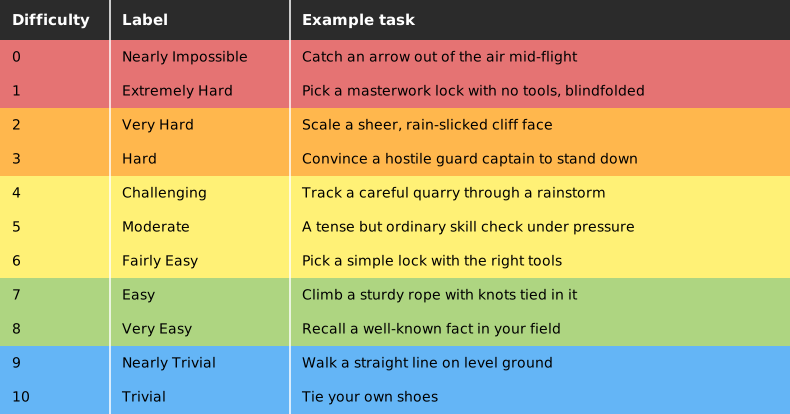
| Difficulty | Label | Example task |
|---|---|---|
| 0 | Nearly Impossible | Catch an arrow out of the air mid-flight |
| 1 | Extremely Hard | Pick a masterwork lock with no tools, blindfolded |
| 2 | Very Hard | Scale a sheer, rain-slicked cliff face |
| 3 | Hard | Convince a hostile guard captain to stand down |
| 4 | Challenging | Track a careful quarry through a rainstorm |
| 5 | Moderate | A tense but ordinary skill check under pressure |
| 6 | Fairly Easy | Pick a simple lock with the right tools |
| 7 | Easy | Climb a sturdy rope with knots tied in it |
| 8 | Very Easy | Recall a well-known fact in your field |
| 9 | Nearly Trivial | Walk a straight line on level ground |
| 10 | Trivial | Tie your own shoes |
Per-Attribute example tasks (a Fire example vs. an Earth example at the same Difficulty) are deferred until the rest of the system is further along.
Critical results, regardless of target number:
- A roll of 2 (both dice show 1) - critical success. In combat this has a specific effect, see Critical Hits.
- A roll of 20 (both dice show 10) - catastrophic failure.
Advantage / Disadvantage
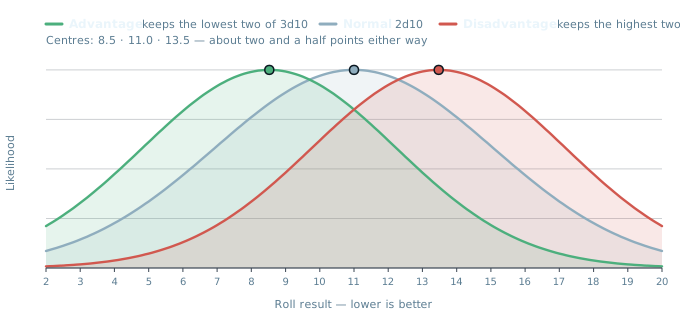
Advantage rolls 3d10 and keeps the lowest two (summed); Disadvantage rolls 3d10 and keeps the highest two (summed) - roll-under, so lower is always better. Usable wherever a specific rule grants it - currently the Expert/Master Skill Training Tiers, a character’s off-hand (below), but not restricted to those.
Stacking: count the sources. Each source of Advantage is +1 and each source of Disadvantage is -1; add them up. 1 or more rolls at Advantage, 0 rolls normally, less than 0 rolls at Disadvantage. Neither one compounds - three sources of Advantage is still just Advantage, and the count only decides which side of zero you land on.
Off-hand: performing a task that requires manual dexterity or precision (attacking, fine manipulation, etc.) with your off-hand imposes Disadvantage on the roll. Ambidextrous removes this penalty.
Untrained Rolls
If a character has no applicable Skill for the task, they still roll - but the Attribute does not apply. Target number is Difficulty alone (0-10), not Attribute + Difficulty. Having an applicable Skill is what lets the Attribute apply at all.
This is intentional: under the 2d10 curve, an untrained character faces poor odds at anything above Difficulty 5 or so, and Difficulty 0 (Nearly Impossible) is a flat impossibility untrained (target 0 is below 2d10’s minimum roll of 2).
Opposed Rolls
When two characters want opposite things - one sneaking, one watching; one hiding a lie, one looking for it - both roll, against the same Difficulty, each on their own Element and Skill. If only one succeeds, that one wins. If both succeed, whoever beat their target number by more wins. A tie, or both failing, goes to whoever is resisting: nothing changes.
A creature doesn’t roll its side. Its card prints the number - Stealth 6 vs. Perception means the character rolls Perception at Difficulty 6 (see how to read a stat block).
Helping
A character who is at least Trained in the Skill being rolled can help, giving the roller Advantage. It is one source like any other (see Advantage / Disadvantage): a second helper adds no further Advantage but can cancel a source of Disadvantage, and a roller who is Adept or better already has Advantage, so help only matters to them when something is working against them. A helper shares the consequences: on a catastrophic failure, they are caught in it too.
Trying Again
A failed roll stands until something changes - a different approach, a better tool, someone helping, more time. Then it is a new roll, with its own chance of a catastrophic failure. Rolling the same thing again because the first result was disappointing isn’t an option.
Group Rolls
When everyone has to pull something off - sneaking past a guard, crossing a ledge - everyone rolls, and the group succeeds if at least half of them succeed. The ones who are good at it cover for the ones who aren’t. A catastrophic failure spoils it for the whole group, however the rest rolled.
Taking Your Time
With nothing coming and nobody watching, a character can trade time for a better chance: take the next Time Band up - a Minute instead of a Round, an Hour instead of a Minute - and roll with Advantage. Where failing wouldn’t cost anything either, there usually shouldn’t be a roll at all.
Time Bands
A standard ladder of duration used wherever a rule needs to name “how long”: Round → Minute → Hour → Scene → Day → Week → Month → Year → Decade → Century. A Round is about 6 seconds, so a Minute is exactly 10 of them. The Round is the base unit - any duration described elsewhere in the rules is stated in Rounds unless a longer band is explicitly named.
Rests
Two recovery windows referenced throughout the rules - Short Rest and Full Night’s Rest - anchored to real time. A Short Rest takes roughly 1 hour of genuine downtime; only one Short Rest’s worth of recovery can be gained between Full Night’s Rests, no stacking a second hour spent resting for a second round of healing. A Full Night’s Rest is a full, largely uninterrupted night’s sleep.
Ki
Ki Infusion
Covers all three attack types - Physical, Social, and Mental - with the same shape and the same currency. The baseline attack die is raw and unboosted - d10 vs. the defender’s wall (Soak/Presence/Psyche as appropriate), so a wall of 10 fully negates it, guaranteed (0% connect). Roll the attack’s dice first, then spend. With the dice on the table, the player picks which individual ones to boost and spends 1 Ki per die - each boosted die adds the player’s own matching sub-stat (Ferocity for Physical, Presence for Social, Psyche for Mental) to its result. A boosted die is compared as d10 + [matching sub-stat] vs. the wall, same threshold rule (result > wall connects).
Spending after the roll means no Ki is ever wasted - not on a die that already got through, and not on one too far under the wall for the sub-stat to save. It buys the same damage as committing blind would have, for roughly half the Ki.
This is a direct Ki spend, the same category as spending Ki to preserve a Level and Bump Action Bracket - not a Fate Token spend, so it does not count against Stamina’s per-Scene spend cap.
Full negation is still the honest baseline: an unboosted attack against a maxed wall can never get through, but a player willing to spend Ki can crack even a Soak/Presence/Psyche of 10 - a boosted die with a matching sub-stat of 10 is a guaranteed connect, while a rating of 2 only gives a 20% chance per boosted die.
Ki Spend to Preserve a Level
A player may spend 1 point from Ki (the pool - distinct from Fate Tokens, the resource players earn/spend) to cancel the loss of one Level from any of the Vitals - Health, Poise or Sanity - at a cost of 1 Ki per Level preserved. Multiple Ki can be spent to preserve multiple Levels, even across more than one Vital from the same attack. All three work the same way here - a die that got through a wall costs a Level, and a point of Ki buys that Level back before it is lost.
Attributes
The Elements
Five attributes, each linked to a classical element. Each pairs a domain (narrative flavor) with a mechanical role (two sub-stats).
| Attribute | Domain | Mechanical Role |
|---|---|---|
| Earth | Physical power/endurance | Soak / Potence |
| Air | Agility/adaptability, mind/intellect | Initiative / Psyche |
| Fire | Drive/aggression | Ferocity / Presence |
| Water | Perception/empathy | Stamina / Health |
| Moira | Fate/destiny/the supernatural | Atropos / Klotho |
Attributes are scored 1-10 (1 = lowest, 10 = highest).
Sub-Category Allocation
Every Attribute’s Mechanical Role is two sub-stats. The Attribute’s own score is always the number used to roll (see Core Mechanic) - it is never reduced or consumed by the split below.
Separately, that same score generates a pool of points equal to the Attribute’s rating, which the player allocates across its two sub-stats - a player choice, not an even split. An Attribute of 10 both rolls as 10 and grants 10 points to divide, e.g. 7 Soak / 3 Potence, or 5/5, or any other division. What each allocated point actually buys in each sub-stat is defined case by case, sub-stat by sub-stat.
This allocation is permanent. Once a point is spent into a sub-stat, it’s spent - there’s no reallocating a pair’s split later, same as Descriptors being fixed once chosen.
Sub-Stat Descriptors
For every point a character allocates to a sub-stat, they gain one Descriptor - a short player-chosen word capturing one specific flavor of that sub-stat for this character. E.g. 3 points in Soak might yield Hardy, Weathered, Unyielding - three distinct ways the character shrugs off harm, not three copies of the same idea.
Descriptors are core traits. They’re free at character creation (no separate cost beyond the point that earns them) and fixed once chosen - there is no way to buy an extra Descriptor beyond what a sub-stat’s points earn, at creation or later. A character who wants a broader spread of Descriptors gets there by raising the sub-stat, not by purchasing the trait on its own.
Descriptors are one or two-word adjectives, not phrases - Brutal, Brawny, Indefatigable, Headstrong, not “Killer Instinct, Relentless, and Simmering Rage all at once.” Tight, punchy, and easy to say out loud at the table.
Every Skill defaults to an Attribute/Element (see Skills). Descriptors are the concrete hook a player points to when challenging that default - grounding “I’m using Fire here because I’m being Brutal” in an established character fact instead of an improvised justification each time.
Sample Descriptors, 15 examples per sub-stat to jump-start character creation - these are just starting points, not a fixed list. A player is always free to write their own instead, as long as it’s a short adjective capturing a real flavor of that sub-stat:
| Sub-Stat | Sample Descriptors |
|---|---|
| Soak | Hardy, Rugged, Stoic, Weathered, Unyielding, Sturdy, Grizzled, Armored, Callused, Thick-Skinned, Leathery, Battle-Worn, Steeled, Resistant, Flinty |
| Potence | Brawny, Herculean, Mighty, Strapping, Muscular, Titanic, Forceful, Robust, Hulking, Sinewy, Vigorous, Burly, Formidable, Stout, Iron-Armed |
| Initiative | Alert, Reflexive, Twitchy, Vigilant, Quickened, Sharp-Eyed, Instinctive, Keen, Fleet, Snappy, Watchful, Attentive, Sharp, Nimble-Minded, Anticipatory |
| Psyche | Steadfast, Composed, Disciplined, Unshaken, Focused, Resolute, Headstrong, Serene, Level-Headed, Calm, Iron-Willed, Grounded, Unflappable, Determined, Clear-Headed |
| Ferocity | Brutal, Savage, Relentless, Feral, Merciless, Ruthless, Vicious, Predatory, Fierce, Aggressive, Bloodthirsty, Wrathful, Untamed, Cutthroat, Rabid |
| Presence | Magnetic, Commanding, Charismatic, Radiant, Imposing, Captivating, Dominant, Alluring, Striking, Charming, Bold, Regal, Magnificent, Unforgettable, Larger-Than-Life |
| Stamina | Indefatigable, Tireless, Enduring, Hardened, Persistent, Unflagging, Dogged, Steady, Untiring, Unwavering, Gritty, Marathon-Bodied, Long-Winded, Driven, Unrelenting |
| Health | Hale, Vital, Resilient, Stalwart, Ironclad, Unbreakable, Durable, Tenacious, Hearty, Sound, Thriving, Hard-to-Kill, Long-Lived, Wholesome, Sturdy-Framed |
| Atropos | Fated, Untouchable, Uncanny, Ghostly, Warded, Veiled, Overlooked, Passed-Over, Unmarked, Inviolate, Unsevered, Thread-Bound, Unreachable, Spared, Unbroken |
| Klotho | Lucky, Charmed, Serendipitous, Auspicious, Star-Touched, Timely, Quickening, Renewing, Replenishing, Rekindling, Brimming, Deep-Welled, Spring-Fed, Ever-Spinning, Unspent |
The Passive Wall Triad - Soak, Presence, Psyche
Every attack, regardless of type, resolves in the same two steps. First, a to-hit roll: the attacker’s Attribute (Earth, Air, Fire, or Water - whichever fits the attack) against the target’s Defense for that attack type as Difficulty, no Skill involved - a straight Attribute-vs-Defense roll, the same formula whether the attack is a fist, a threat, or a mind reaching where it isn’t welcome. Only a success reaches step two. Then the attack’s dice are resolved against the relevant wall stat, per die:
- Soak - wall against Physical damage dice.
- Presence - wall against Social attack dice.
- Psyche - wall against Mental attack dice.
Presence (Fire) and Psyche (Air) both mirror Soak exactly - the identical per-die mechanic, just resisting a different attack type. All three sub-stats are passive gives, the same way Health is: a flat number a character simply has, doing its job automatically with no roll or spend required.
For all three: each attack die is resolved individually against the relevant wall stat. Die ≤ wall stat is fully absorbed; die > wall stat connects. A wall stat of 10 guarantees 0% connect chance per die - true, complete negation - unless the attacker spends Ki (1 per die) to add their own matching Attack sub-stat to that specific die, per Ki Infusion. A connecting Physical die costs a Health Level, a connecting Social die costs a Poise, a connecting Mental die costs a Sanity - the three together are your Vitals.
The Vitals - Health, Poise, Sanity
The wall triad is what a die has to beat. The Vitals are what it costs when it does - the three things an attack can take from you, and the only three. Each is 5 plus a sub-stat, counted in Levels rather than points, and each runs the same distance below zero as it does above: see Health Levels, Poise and Sanity for what waits at each end of the row.
Ki is not a Vital. The Vitals are taken from you; Ki is the pool you spend, including to preserve a Level on any of them.
Choosing the Attacking Element
Which Element applies to a to-hit roll is set by how the character is attempting the attack, not by their weapon or a Skill - there are no weapon-specific attack skills. The same weapon can be used with any of the four elements depending on the approach described:
- Earth - Force. Overpowering the target through raw physical strength - “I put my entire weight behind the blow and smash through his guard.”
- Air - Precision. Succeeding through speed, timing, or exploiting an opening - “I wait for him to move his guard, then thrust through the opening.”
- Fire - Intensity. Overwhelming through aggression and ferocity - “I charge him screaming and attack relentlessly, trying to force him back.”
- Water - Adaptation. Responding to the opponent and turning their action back on them - “I let his attack pass, redirect his momentum, and strike when he overextends.”
- Moira - Fate. The opening that was always going to be there, taken - “I say the thing he has been afraid somebody would notice.” Social and Mental attacks only.
The first four examples all use the same sword - the weapon never determines the element. Moira never governs a Physical attack: fate does not swing a blade, and no amount of luck makes a bat hit harder. It carries a Social or Mental attack readily, because finding the one word that lands is exactly what fate is for. Atropos only ever sets Defense, whatever the attack.
The player describes the attempt before rolling, and the GM confirms which element fits - not chosen retroactively to fish for a better number. This choice only sets which Attribute feeds the to-hit roll; it’s not a second roll, doesn’t change the attack’s category (Physical/Social/Mental), and doesn’t change what damage the weapon deals.
What does set the category is the attack itself. A weapon deals Physical dice against Soak no matter which Element carried the to-hit; a Gift deals whatever its own entry states; and Signature Move is built with its attack source and its target wall chosen independently, so a Presence-powered Move can resolve against Soak. The Element is approach. The wall is category.
Earth
Physical Attacks - Weapon Damage & Per-Die Resolution
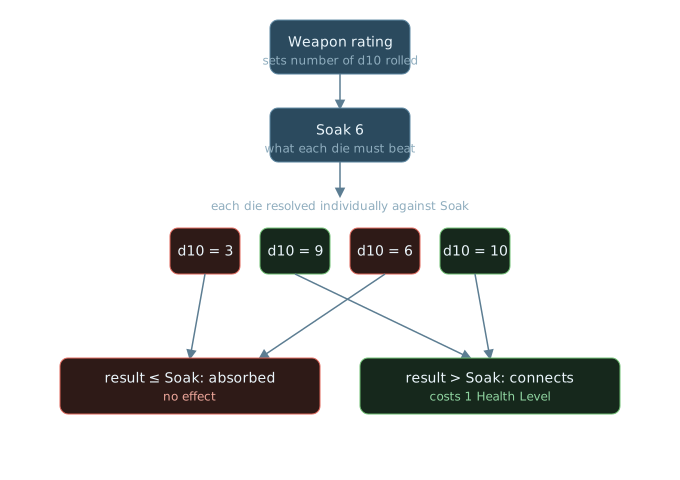
After the attacker’s to-hit roll succeeds, the weapon in use sets how many d10 are rolled - see weapons.md for the base list. Each die is resolved individually against the defender’s Soak, not summed together:
- Die result > Soak - that die connects, and costs the defender one Health Level.
- Die result ≤ Soak - that die is fully absorbed, no effect.
Soak 10 guarantees 0% connect chance per die - true, complete negation. A heavier weapon (more dice) doesn’t overwhelm Soak mathematically - it just means more independent chances to connect, so a single attack can plausibly cost a defender multiple Health Levels at once if several dice connect (subject to the crossing-zero throttle once the defender is already at 0).
Armor & Called Shots
Worn or carried armor (see Weapons & Equipment) has its own Hardness (a threshold on the same 0-10 scale as Soak) and its own Health Levels, both tracked separately from the wearer’s. Every armor item covers one or more of four Zones: Center of Mass, Head, Arms and Legs. An item that covers several Zones is still one item, with one Hardness and one set of Health Levels, whichever Zone a die arrives at.
While it still has Health Levels remaining, armor intercepts every die aimed at the Zone it covers, before the wearer’s own Soak ever comes into play:
- Die result ≤ Hardness - deflected for free. No effect on the wearer, no cost to the armor.
- Die result > Hardness - still fully stopped, the wearer takes nothing - but the armor takes the hit instead. An armor item never loses more than 1 Health Level per attack, no matter how many of that attack’s dice exceeded its Hardness.
Once an armor item’s Health Levels reach 0, it’s broken. It stops covering its Zone entirely - dice resolve straight against the wearer’s own Soak, per the normal per-die rule above - until repaired (a downtime/GM-adjudicated task, not modeled further here).
Ki Spend to Preserve (see above) only ever applies to the wearer’s own Vitals - it can’t prevent or undo an armor Health Level loss.
- Armor doesn’t stack within a Zone. If a character owns more than one item covering the same Zone, only one can be worn there at a time - their choice which.
- A normal attack always resolves against Center of Mass armor. Armor that covers only the Head, Arms or Legs does nothing against it.
- A called shot - an attack aimed at something specific rather than at the target generally: a hand, a knee, a strap, a weapon, a sensor. It’s an empowered action - declared as a Slow Action, with no Advantage (Aim is the empowered action that gives Advantage) - and spending Ki to bump the bracket carries it along rather than cancelling it. What a successful called shot accomplishes is the GM’s call, and depends on what was aimed at. Where it interacts with armor, a called shot to the Head, Arms or Legs resolves against whatever the defender wears on that Zone (or no armor at all, if nothing covers it), and armor that covers only the Center of Mass doesn’t apply to it.
Potence
Potence (Earth’s other sub-stat: raw physical power/strength - carrying capacity, immovability, mass, forcing/breaking things) splits into two jobs:
- Flat passive give (mundane use, no roll) - Potence directly sets a Carrying Capacity and a Break Threshold.
-
Carrying Capacity (how much weight a character can lift/carry/drag under ordinary conditions):
Potence² × 10, in kg.Potence Carrying Capacity 1 10 kg (~22 lbs) 2 40 kg (~88 lbs) 3 90 kg (~198 lbs) 4 160 kg (~353 lbs) 5 250 kg (~551 lbs) 6 360 kg (~794 lbs) 7 490 kg (~1,080 lbs) 8 640 kg (~1,411 lbs) 9 810 kg (~1,786 lbs) 10 1,000 kg (~2,205 lbs) -
Break Threshold (the bar an object’s resistance must sit under to be forced open/broken with no contest involved): no separate number, just a direct comparison. If a character’s Potence is equal to or greater than the target item’s Hardness, it breaks or forces open automatically, no roll. If Potence is lower, it isn’t a no-contest job anymore; that’s what the contested dice pool below is for.
-
- Contested dice pool - when forcing, breaking, or moving something that’s actively resisting (a grapple, a door someone’s holding shut, a struggling creature), Potence itself sets how many d10 are rolled. Each die is compared individually against the target’s relevant resistance: a grappled/restrained creature’s own Soak, or - for inanimate resisting things - the item’s own Hardness (GM-set, on the same 0-10 scale as Soak - see Materials). Each connecting die represents one increment of success, costing the object one of its Health Levels - same binary hit-box shape as a character’s, just scaled to the object’s durability instead of a body.
Materials: Hardness and Health Levels
Living bodies have Soak. Items and armor have Hardness, on the same 0-10 scale. The numbers below are for a piece about the size of a person: a door, a section of wall, a car door.
- Attacking or breaking an item costs it one Health Level for each die over its Hardness. At 0 it’s broken. Armor that is shielding someone is the exception: it never loses more than one Health Level per attack - see Armor & Called Shots.
- Cover can be shot down, where that’s plausible (GM’s call). Attack the cover as an item; at 0 Health Levels it stops being cover. A knife won’t dig through a concrete wall, and a pistol won’t move a boulder.
| Material | Hardness | Health Levels | Examples |
|---|---|---|---|
| Paper, cardboard, cloth, canvas | 0 | 1 | Tent wall, curtain, boxes |
| Packed snow | 1 | 3 | Snowbank, snow wall |
| Plain glass | 1 | 1 | Window, glass door |
| Rope, zip ties | 2 | 1 | |
| Drywall | 2 | 2 | Interior wall |
| Light wood | 2 | 2 | Chair, fence board |
| Ice | 3 | 2 | Frozen pond, ice sheet |
| Thin wood | 3 | 2 | Interior door, table |
| Chain-link, cheap locks | 3 | 1-2 | Fence, padlock |
| Sandbags, packed earth | 4 | 4 | Berm, sandbag wall |
| Sheet metal | 5 | 3 | Car door, vending machine |
| Solid wood | 5 | 3 | Reinforced exterior door, tree trunk |
| Brick | 6 | 4 | House wall, chimney |
| Stone | 7 | 5 | Boulder, stone wall |
| Steel plate | 7 | 4 | Security door, dumpster |
| Bulletproof glass | 7 | 3 | Bank teller window |
| Hardened steel | 8 | 3 | Handcuffs, a chain |
| Reinforced concrete | 8 | 5 | Bunker, parking garage pillar |
| Vault steel | 9 | 6 | Bank vault door |
| Fortress stone | 9 | 8 | Castle gate, fortress wall |
| Modern vault | 10 | 8 | High-security vault |
Air
Mental Attacks - Gift-Sourced Only
A Mental attack resolves exactly like a Physical or Social one: to-hit with the fitting Mental Defense (10 − Presence) using the fitting Element, then dice resolved individually against their Psyche, a connecting die costing one Sanity. Ki Infusion adds the attacker’s own Psyche, 1 Ki per die.
There is no baseline dice source, and this is deliberate. A weapon gives Physical dice and a Training Tier gives Social dice; nothing gives an ordinary character Mental dice. The pool has to come from one of:
- a Gift that states one - including a Signature Move built to resolve against Psyche, since a Signature Move is a Gift;
- a creature’s own stated pool - see the adversary stat blocks, where a Nightmare’s Cry is dice pool 6 and needs no to-hit roll at all.
Psyche is therefore the one wall a character without a Gift can never test. A fist and a bad word are standard human equipment; a mind that pushes on another mind is not. Treat a player asking how to attack Psyche unaided as answered - they can’t - rather than as a gap to house-rule around.
Sanity
Sanity mirrors Health Levels too, tracking a character’s grip on their own mind against Mental attack.
PC Sanity = 5 + Psyche. Each Level is a binary hit-box.- Crossing zero works identically to Health Levels.
- The negative range mirrors the positive one, exactly as Health Levels and Poise do: a character with 9 Sanity is Overwhelmed at 0 and Shattered from −1 down to −8. Reaching −(full Sanity) is the floor. The character picks up a temporary Mental scar effect, the same way Overwhelmed does, and Sanity resets to 0: Overwhelmed again, not restored. The permanent Mental scar from having gone below 0 stands regardless.
- General recovery matches Health/Poise: Short Rest heals
Psyche ÷ 2(round up, minimum 1); Full Night’s Rest heals fully.
At 0 Sanity, a character is Overwhelmed: they take one Mental scar effect, GM’s pick, for as long as they stay Overwhelmed, and are at Disadvantage on rolls. They can still act on their own. Overwhelmed clears when the character is removed from the stimulus that caused it and given a chance to rest, or by spending 1 Ki, which brings Sanity back to 1.
Below 0, a character is Shattered: panicky, babbling, unable to act on their own - they have to be led or dragged. Shattered clears when 1 Ki is spent or a Short Rest or Full Night’s Rest passes, either of which restores Sanity only to 1, not fully - normal recovery resumes from there on the next rest.
Mental scars: dropping to 0 Sanity leaves a purely cosmetic mental tell (a tic, an intrusive thought, a private ritual), no mechanical effect beyond Overwhelmed’s own temporary effect above. Dropping below 0 leaves a Mental scar, however the character recovers afterward - even a Ki-funded refill doesn’t erase it. See Scars for the list and how one heals.
Fire
Social Attacks - Training & Per-Die Resolution
A social attack resolves exactly like a Physical one: to-hit against the target’s Social Defense (10 − Psyche), then damage dice resolved individually against their Presence, a connecting die costing one Poise.
The dice come from the attacker’s Training Tier in whichever Skill they are using. A weapon sets Physical dice because anyone can pick one up; nothing on a character sheet says how hard a sentence hits, so the number is what they have practised.
| Tier | Dice | |
|---|---|---|
| 0 | Untrained | 1 |
| 1 | Trained | 3 |
| 2 | Adept | 4 |
| 3 | Expert | 5 |
| 4 | Master | 6 |
Untrained rolls 1 for the same reason bare fists do. Master reaches 6, one past the heaviest ordinary weapon in weapons.md, and that is deliberate: Poise has no death threshold, so nothing on this ladder can kill.
The Skill also sets the Element. Every Skill has a home Element (skills.md), so naming what you are doing settles the dice and the to-hit Attribute together. Fire carries Ridicule, Intimidation, Persuasion, Public Speaking, Performance, Leadership and Deception; Moira carries Insight. A Descriptor can still argue for a different Element, as with any Skill roll.
Charm and Seduction are not attacks. They win a target over rather than take them apart, and cost no Poise. Etiquette is the GM’s call: in a room where protocol matters, naming the one somebody just broke is a weapon.
Ki Infusion applies as it does to any attack - 1 Ki per die, adding the attacker’s own Presence to that die.
The dozens is this rule run in alternation: two people trade attacks in front of a crowd nobody can walk out of, and it grinds. First participant to 0 Poise is Flustered; below 0, Humiliated.
Poise
Poise mirrors Health Levels, tracking composure under Social attack instead of Physical.
PC Poise = 5 + Presence. Each Level is a binary hit-box, same shape as Health.- At 0 Poise, a character becomes Flustered.
- Crossing zero works identically to Health Levels: a single attack can never carry a character straight past 0 into negative territory - excess connecting dice are discarded, landing exactly at 0. Once already at 0, any further attack can only remove 1 Poise, total, regardless of how many dice connect.
- Below 0 Poise, a character becomes Humiliated. There is no death threshold for Poise - social trauma can leave lasting damage, but never kills on its own.
- The negative range mirrors the positive one, exactly as Health Levels do: a character with 8 Poise is Flustered at 0 and Humiliated from −1 down to −7. Reaching −(full Poise) is the floor. Poise resets to 0 - Flustered again, not restored - and the character takes 1 Sanity Level.
- That Sanity Level bypasses the Psyche wall entirely; no die is rolled against it. This is not an attack on the mind, it is standing collapsing into it, and the armour for one is not the armour for the other. It can still be prevented by Ki Spend to Preserve a Level, the same as any other Level. A wall of 10 is not immunity - Ki Infusion cracks it like any other, it simply costs the attacker more than the point is worth.
Recovery: Short Rest heals Presence ÷ 2 (round up, minimum 1); Full Night’s Rest heals fully. Below 0, see the refill rule below: either rest, or 1 Ki, brings Poise back to 1.
There is no full refill. Ki buys a Poise Level back as it is lost, the same as Health or Sanity - see Ki Spend to Preserve a Level. Below 0, spending 1 Ki - or taking a Short Rest or Full Night’s Rest - restores Poise to 1, not to full, exactly the shape Sanity’s Shattered recovery uses; normal recovery resumes from there.
Poise scars: dropping to 0 leaves a purely cosmetic social tell (a nervous habit, a reputation quirk), no mechanical effect. No Gift grants immunity to this - intentional. Dropping below 0 leaves a Social scar - see Scars. Poise damage never leaves a physical mark, and no Gift heals a Social scar: a scarred reputation can’t be treated or healed - it has to be rebuilt.
Water
Health Levels
Health Levels are a count of discrete hit-boxes, not a numeric HP pool. Each Health Level can absorb damage once - a binary hit-box, not a container with its own capacity.
Every character starts with 5 Health Levels, flat, before anything else is added.
PC Health Levels = 5 + Health (sub-stat)- the flat baseline, plus whatever a PC invests in Water’s Health sub-stat.- NPCs are built the same way as PCs - most with the Character Creator, at the power level the GM chooses - so their Health Levels follow the same formula. A Gifted NPC has Ki the way a PC does; an ordinary one has 1 Ki. Only a special NPC holds Fate Tokens of their own.
At 0 Health Levels, a character falls unconscious and can’t act. Below 0 they are Dying: still unconscious, and out of the fight until something gets them up. Dying doesn’t get worse on its own - only further damage moves a character toward death. Health Levels can still be tracked into negative territory from further damage, and the negative range mirrors the positive one - a character with 7 Health Levels is unconscious at 0, Dying from −1, and dead at −7. Whatever it took to put them down, it takes that much again to finish them. Ordinarily that range plays out off-screen, since an unconscious character can’t act or be aware of it; Unstoppable is the exception that lets a character stay conscious and act throughout it instead of blacking out at 0.
Getting up. A Dying character can spend a Fate Token on Get Back Up - even while unconscious - and is at 1 Health Level, conscious and able to act. Stabilizing them - First Aid, a trauma kit, or a Gift that says so - brings them to 0 instead: no longer Dying, still unconscious, and healing at the normal rates from there.
Falling unconscious at 0 is unconditional - it happens on the way down no matter how tough a character is. The symmetry below zero is the point. Everyone gets the same second chance their own toughness already earned them, rather than a separate allowance bolted on beside it. A character who put nothing into Health still has five Levels and five more below zero: quick to drop, but never one unlucky round from a funeral because of a choice made at creation. Every point of Health is still worth two hits - one before they drop, one after.
Crossing zero: a single attack can never carry a character straight past 0 into negative territory. If enough connecting dice from one attack would carry a character’s Health Levels below 0, the excess is simply discarded - they land exactly at 0, no further, no matter how many dice connected. Once a character is already at 0 Health Levels - unconscious under the rule above, or still conscious via Unstoppable - any further attack can only remove 1 Health Level, total, regardless of how many dice connect.
Named and Unnamed. Player characters and named NPCs get everything above: unconscious at 0, Dying below it, recovery and scars. An unnamed NPC who reaches 0 is out - of the fight and of the story - and whether that’s dead or down is the GM’s call. Giving an NPC a name is how the GM says they can survive.
Health Level Recovery
- Short Rest: heal Health Levels equal to your Health sub-stat divided by 2, round up, minimum 1.
- Full Night’s Rest: heal all lost Health Levels, back to full.
- Reduced below 0 Health Levels: the rates above stop applying. A Short Rest recovers nothing. A Full Night’s Rest recovers 1 Health Level, and only one, until back to 0.
Scars
Going to 0 leaves a mark. Going below it leaves something that lasts.
At 0, any Vital leaves a purely cosmetic mark, with no mechanical effect: a scar, a limp or a changed voice from Health; a nervous habit or a reputation quirk from Poise; a tic, an intrusive thought or a private ritual from Sanity. The Healing and Regeneration Gifts both grant immunity to the Health one, for the target they’re used on.
Below 0, the character takes a scar: one effect from the matching list below. Health leaves a Physical scar, Poise a Social one, Sanity a Mental one. The GM picks it, or the GM and the player talk it over and decide together.
- One scar per crossing. Each fresh crossing below 0, after healing back up in between, adds one more. Going deeper in one crossing doesn’t add a second, and the same scar can’t be taken twice.
- A scar isn’t a Flaw. It grants no Flaw points, and a scar causing trouble never earns a Fate Token.
- A scar is permanent until something heals it.
Healing a scar. The count is how far below 0 the character went: −1 is one, −7 is seven.
| Scar | By Gift | By Adder | By Skill |
|---|---|---|---|
| Physical | Healing or Regeneration: that many Days | - | Medicine: that many Months |
| Mental | Restoration: that many Days | Talking Down (Telepathy/Empathy) or Taking the Edge Off (Memory Manipulation): that many Weeks | Psychology: that many Months |
| Social | - | - | Networking: that many Months |
A Gift or Adder needs dedicated time across that span, as its own entry says. A Skill needs regular work across it from someone Trained in that Skill - for Networking, the scarred character themselves. A scarred reputation can’t be treated or healed - it has to be rebuilt. No Gift reaches a Social scar.
Physical scars
| Scar | Effect |
|---|---|
| Bad Knee | Movement Rate −1m. Disadvantage on Athletics to jump. |
| Stiff Shoulder | Disadvantage on Thrown Weapons and Archery. |
| Shaky Hand | Disadvantage on Sleight of Hand, and on Firearms past Close. |
| Ribs That Set Wrong | Your Stamina baseline for holding breath and running flat-out is halved. |
| Ringing Ear | Disadvantage on Perception by sound. |
| Clouded Eye | Disadvantage on Perception by sight past Close. |
| Weak Grip | Disadvantage on Potence contests to hold on: grapples, climbing, a hand on a ledge. |
| Missing Fingers | Disadvantage on Crafting, Electronics and Security by hand. |
| Limp | Disadvantage on Acrobatics, and in chases on foot. |
| Scarred Lungs | Disadvantage on endurance checks in smoke, cold or thin air. |
| Weather in the Joints | In cold or rain, Disadvantage on Athletics and Acrobatics. |
| Tender Spot | Ki can’t preserve the first Health Level you lose in a Scene. |
| Disfigured | Disadvantage on Disguise. People who’ve seen you once remember you. |
| Bad Back | Disadvantage on Athletics to lift, carry or drag. |
| Slow to Clot | First Aid and Medicine on you are at Disadvantage. |
| Night Blind | Disadvantage on Perception and Driving in the dark. |
| Chronic Pain | Your baseline for any sustained exertion is one unit shorter. |
| Burn Scars | Soak counts 1 lower against fire and heat. |
| Old Break | A hit that costs 2 or more Health Levels also leaves you Off Balance. |
| Wheeze | Disadvantage on Stealth when you’ve moved this round. |
Social scars
| Scar | Effect |
|---|---|
| The Story Goes Around | Disadvantage on Intimidation against anyone who’s heard what happened. |
| Known Face | Disadvantage on Disguise and Stealth where it happened. |
| Stammer | Disadvantage on Public Speaking and Performance in front of an audience. |
| Sore Spot | A Social attack that brings it up gets 1 extra die. |
| Burned Bridge | Disadvantage on Networking with one Contact or faction who saw it. |
| Eyes Down | Disadvantage on Leadership when the person who did it is present. |
| Tell | Insight to read you is at Advantage. |
| Gives Ground | Disadvantage on Barter and Bribery. |
| Rattled | Losing a Poise Level leaves you Distracted. |
| The Nickname | Ridicule that uses it is at Advantage against you. |
| Out of Place | Disadvantage on Etiquette at anything formal. |
| It’s on Video | Once a session the GM can say someone in the Scene has seen it. Disadvantage on Persuasion with them. |
| Can’t Let It Go | When it’s thrown at you in public, Disadvantage on everything else until you answer it. |
| Nervous Laugh | Disadvantage on Charm and Seduction when it matters. |
| Quiet Voice | Disadvantage on Intimidation. |
| Flushes | Disadvantage on Deception about yourself. |
| Won’t Ask | You can’t be Helped on Social rolls. |
| On the Record | Disadvantage on Bureaucracy and Law wherever the record exists. |
| Stage Freeze | Your first Social roll in front of a crowd each Scene is at Disadvantage. |
| Touchy Subject | Ki can’t preserve Poise against a Social attack that brings it up. |
Mental scars
| Scar | Effect |
|---|---|
| The Trigger | One sound, smell or sight leaves you Distracted when it turns up. |
| Night Terrors | A Full Night’s Rest refills Ki only as a Short Rest does (Klotho), unless somebody keeps watch with you. |
| Hypervigilant | You can’t be Surprised, and you can’t take a Short Rest anywhere unsecured. |
| Phobia | Disadvantage on every roll while the thing is within Close. |
| Lost Time | A stretch of memory is gone. The GM knows what’s in it. |
| Intrusive Memory | A catastrophic failure also leaves you Distracted. |
| Checks the Exits | Your first action in each Scene is at Slow. |
| Flat | Disadvantage on Performance and Charm. |
| Paranoid | You can’t be Helped by anyone you haven’t known a Month. |
| Startle | A sudden loud noise costs you Fast for the round. |
| Drifts | Once a session the GM can say you drift. Disadvantage on Perception for that Scene. |
| Insomnia | Miss a Full Night’s Rest and you wake Exhausted. |
| The Voice | You answer it under your breath. Disadvantage on Stealth. |
| Survivor’s Guilt | While an ally is Dying, you can’t spend a Fate Token on yourself. |
| Freezes | Surprised lasts a round longer. |
| Tunnel Vision | Under Mental attack, you can’t Help or be Helped. |
| It Knows You | Mental attacks from the thing that did it get 1 extra die. |
| The Dark | Disadvantage on every roll in darkness without a light. |
| Fixated | While it’s in the Scene, Disadvantage on anything that isn’t about it. |
| Cracks | Disadvantage on Academics, Research and Law in combat. |
Making a new scar. The lists are a starting point. When none of them fits what happened, make one.
- Tie it to the harm. A scar comes from one moment - the knife that went in under the ribs, the speech that fell apart in front of the whole room, the thing in the basement. The best ones are the ones anybody at the table can point back to.
- Match the Vital. A Social scar is never a wound, and a Physical scar never changes what anybody thinks of you.
- Keep it narrow. A scar should bite about once a session, not every roll. Build it from Disadvantage on one or two named Skills or one kind of situation; a Condition that one specific trigger sets off; one extra die for a particular kind of attack against you; a small cut, in one narrow case, to something you’d otherwise always have - a Rest, your Movement Rate, your Fast Bracket, a Ki use, being Helped; or plain story - a lost memory, a name that sticks, a door that’s closed to you.
- Never a penalty on every roll, a lost Attribute or sub-stat point, fewer Health Levels, or anything that ends the character. Scars stack, and a scar that hits everything turns three bad nights into a character nobody wants to play.
Moira
Klotho
Two passive functions, both “gives” like Health/Soak/Presence/Psyche - no roll, no spend:
- Ki Regeneration - a Short Rest restores
KlothoKi (minimum 1); a Full Night’s Rest restores Ki fully. See Ki’s refill. - Lucky Number - a character’s lucky number equals their Klotho rating. Whenever the result of one of the character’s own core rolls - the core roll’s 2d10 or an Advantage/Disadvantage 3d10 - equals their Klotho rating, they immediately gain 1 Fate Token, automatic, no choice, no cost, and never more than one per roll. It’s the roll’s result that has to match, not any individual die within it - does not apply to damage dice pools (weapon dice, Gift dice, the Potence contested dice pool, or any other bulk multi-die pool resolved per-die against a wall).
Defense (Derived Stat)
Defense is how hard a character is to reach - the to-hit target, before any wall is involved. There are three of them, one per attack type, each derived from a different sub-stat:
| Attack | Defense | Sub-stat | Why |
|---|---|---|---|
| Physical | 10 − Atropos |
Moira | Fate. The blade goes where the thread says it goes. |
| Social | 10 − Psyche |
Air | Composure. A remark only lands if it can get a rise out of you. |
| Mental | 10 − Presence |
Fire | Self. A mind reaching in finds the room already occupied. |
No sub-stat both deflects an attack and walls it. Soak walls Physical, Presence walls Social, Psyche walls Mental - and none of those is the sub-stat that set the to-hit target for its own attack type. Presence walls Social but deflects Mental; Psyche walls Mental but deflects Social. Each attack type is therefore answered by two numbers drawn from two different Elements.
That separation is the point. A single sub-stat doing both jobs would dominate every build - measured at a 3-die social attack, folding the wall and the to-hit into Presence widened the spread between Presence 0 and Presence 6 from 2.5x to 5.9x. Split, being hard to insult and being unbothered once an insult lands are two separate purchases.
Defense becomes the attacker’s Difficulty (see the Difficulty Chart); since Difficulty runs 0 (hardest) to 10 (trivial), the subtraction inverts correctly: sub-stat 0 → Defense 10 (trivial to reach), sub-stat 10 → Defense 0 (nearly impossible).
Combat
Critical Hits
A critical doesn’t add dice. It decides them.
Half the attack’s dice, rounded up, connect automatically - no roll, no wall, nothing to beat. A weapon throwing 5 dice lands 3 before anything hits the table, and a wall of 10 stops them exactly as well as a wall of 1 does, which is to say not at all.
The rest roll, and each adds your Klotho. This is amplification, not an attack - the to-hit was made with an Element like any other and has already landed; Klotho only decides how much of it gets through, the same way Ki Infusion adds Ferocity to a die without Fire having thrown the punch. Moira still never attacks. What it does here is what it always does: bend the outcome of something already in motion. Ki Infusion still works on those rolled dice on top of Klotho, 1 Ki per die, adding the matching sub-stat as usual.
A creature has no Klotho. Its critical is the automatic half, and the rest roll unaided.
| Weapon dice | Connect free | Then roll, +Klotho each |
|---|---|---|
| 1 | 1 | - |
| 2 | 1 | 1 |
| 3 | 2 | 1 |
| 4 | 2 | 2 |
| 5 | 3 | 2 |
A critical still cannot kill on its own. The crossing-zero rule applies to the free dice and the rolled ones alike: however many connect, a single attack can only ever bring a target to 0, never past it. Against a player character, or anyone else who survives being dropped, a critical is what takes them out of the fight rather than what ends their life.
Note that the Skill Training Tiers that widen the critical range do not apply here: an attack is a straight Attribute-vs-Defense roll with no Skill involved, so a critical hit lands on a natural 2 for everyone. What does move the odds is Advantage - which Aim, a Slow action, grants, taking a critical from a 1% chance to roughly 2.8%.
Combat Order
- Initiative - rolled once at the start of combat, not re-rolled each round: 1d10 + Initiative (sub-stat). Higher total acts first. This base order holds for the whole fight.
- Declare Action Bracket - each character declares which of the three bands they’re acting in this round: Fast, Normal, or Slow (see below).
- Resolve band by band - all Fast-band characters act first, then all Normal-band characters, then all Slow-band characters. Within each band, characters act in Initiative order.
Action Brackets
| Band | Also called | Actions | Notes |
|---|---|---|---|
| Fast | Reactive | One action | A move, an attack, a single Skill use - or a special action such as Attack on the Run. Acts first, but only gets the one action. |
| Normal | Active | Two actions | E.g. a move and an attack. Acts second. |
| Slow | Measured | One action, with concentration | Acts last, but the single action is an empowered action - Aim for Advantage, a Called Shot, Study a Target, and others - plus a 1m step. (Once magic exists, all spellcasting is a Slow action.) |
The tradeoff across all three: Fast trades action count for going first, Normal is the balanced middle (two actions, middling position), Slow trades speed for a single, more powerful, concentrated action.
A player can spend 1 Ki per step to bump their declared band up (Slow → Normal, or Normal → Fast) - buying back speed at the cost of the resource. Spending 2 Ki moves two steps at once (Slow → Fast).
Combat Actions
The full list - combat actions, empowered actions and special actions - is in Movement: Actions: Dash, Reckless, Full Defense, Reload, Grab, Disarm, Help, Ready, and the small actions. A Gift or weapon that states its own action cost always overrides them.
Movement & Range
Movement Rate: 5 + Air, in meters - the same flat-floor-plus-Attribute shape as Health Levels. Range Bands: Melee (contact, out to ~1m), Close (1 to 10m), Near (10 to 50m), Far (beyond 50m). Everything else - moving in a round, leaving Melee, cover, terrain, climbing, jumping, swimming, chases and travel, for theater of the mind and a 1m-hex map alike - is in Movement.
The status effects defined so far - Off Balance, Distracted, Surprised, Flustered, Humiliated, Exhausted, Staggered, Blinded, Deafened, Grabbed, Prone, Frightened, Envenomed and Bleeding, plus Overwhelmed and Shattered, which Sanity defines. More are expected as combat rules develop further; this isn’t the full list.
Off Balance
A character who rolls a catastrophic failure on any roll during combat becomes Off Balance until the end of their next turn, in addition to whatever else that failure caused.
An Off Balance character rolls everything at Disadvantage. The condition does not stack - a character is either Off Balance or is not, however many catastrophic failures they roll in a round - and it clears on its own with no action or roll required.
A Fate Token spent on Shrug Off an Effect clears it immediately. That spend never undoes the separate consequence the catastrophic failure caused. Never Off Balance grants a reroll of the triggering failure itself - on attack rolls at its first tier, on every roll in combat at its second, and on every roll at its third.
Distracted
A character who loses a Health Level or is the target of a Kotodama effect while resolving a Slow Action Bracket action becomes Distracted, and must roll Atropos + Difficulty to hold focus.
- Success - the action resolves as declared.
- Failure - the action downgrades to a Normal action, and loses whatever its empowerment gave.
Other sources can impose Distracted too - a Gift, an environmental hazard (a collapsing building, a deafening explosion), or GM fiat, whether or not a Slow action is involved. The same Atropos + Difficulty roll applies; outside a Slow action, failure instead imposes Disadvantage on the triggering roll. Concentration grants immunity to being Distracted regardless of source.
Surprised
A character who hasn’t noticed a threat before combat begins is Surprised - typically because they failed to spot it: a Perception roll against the threat’s Stealth, which a creature lists as the Difficulty (Stealth 6 vs. Perception - see how to read a stat block), or an opposing character’s Stealth roll. The GM can also judge that the fiction warrants it.
A Surprised character rolls at Disadvantage on everything - attacks, and any other roll where the defender’s readiness matters - for the remainder of the round they’re caught in. Ends automatically once that round ends. Alertness grants immunity to being Surprised while conscious.
Flustered
A character whose Poise reaches 0 becomes Flustered.
A Flustered character rolls at Disadvantage on all Social rolls, and on any other roll where composure matters (GM’s call, same standard as Surprise), for the rest of the Scene.
A Flustered character may spend an action to roll Presence + Difficulty to shake it off early, ending the condition immediately on success.
Humiliated
A character whose Poise drops below 0 becomes Humiliated - a step past Flustered.
A Humiliated character can’t take the lead, negotiate, or be trusted to speak for the group - socially deferring and complying rather than asserting themselves. Unlike Shattered (see Sanity), a Humiliated character still acts fully on their own; this is social paralysis, not physical.
Humiliated clears once Poise is restored back to 0 (see Poise recovery - Ki, a Short Rest or a Full Night’s Rest each only restore it to 1 while still below 0, never to full).
Exhausted
The only Condition that stacks, in levels 1-5. Taken from pushing an effort past what Stamina covers, or from cold or heat. Effects are cumulative:
| Level | Effect |
|---|---|
| 1 | Disadvantage on Physical rolls |
| 2 | Disadvantage on all rolls |
| 3 | Movement Rate halved; no Fast actions |
| 4 | Every Ki spend costs +1 |
| 5 | Unconscious, until warmed, cooled, or rested |
A Short Rest clears one level; a Full Night’s Rest clears all of them. A level taken from an environment cannot be cleared while the character is still in it - resting in the cold does not clear cold.
Staggered
Something has knocked the rhythm out of a character: a blow that lands wrong, a shock, a moment of not knowing which way is up. Whatever causes it says so.
A Staggered character’s declared Action Bracket drops one step - Fast becomes Normal, Normal becomes Slow. A character who declared Slow still acts, but loses whatever their empowered action would have given.
Ki buys it straight back at the usual rate: 1 Ki per step, the same spend that bumps a band up in the first place. Otherwise it clears at the end of that character’s next turn. Staggered does not stack - a second source while already Staggered does nothing further.
Blinded
A character who cannot see: darkness they have no answer for, a flash, a faceful of something.
A Blinded character rolls at Disadvantage on anything that needs sight, and neither uses nor suffers any effect that requires seeing or being seen - no eye contact, no reading the room, no Gift that depends on the target looking at them.
Ends with whatever caused it. Heightened Senses can sidestep it entirely.
Deafened
A character who cannot hear: an explosion, a pressure wave, water, a Gift.
A Deafened character rolls at Disadvantage on anything that needs hearing, and neither uses nor suffers any effect that has to be heard to work.
Ends with whatever caused it. A Deafened character can still speak, so a Kotodama of their own is unaffected.
Grabbed
Held: a hand, a jaw, a coil, a will.
A Grabbed character’s Movement Rate is 0, and they roll at Disadvantage on everything except escaping or attacking whatever holds them.
Escaping is a contested roll against the grabber’s Potence - or against its Hardness where the grip is a thing rather than a person, GM’s call - the same contest Psychokinesis / Telekinesis already uses.
Prone
Knocked flat: put there by a blow, a fall, or footing that gave out. Prone is always inflicted. Going down on purpose is Belly Down, which is a different thing.
A Prone character can’t attack, and every attack against them gains Advantage. They can’t Crawl.
Recovering from Prone costs one action, which is a Fast character’s entire turn.
Frightened
Something is too much to face. Frightened always has a source, and the condition is of that source rather than of the world in general.
A Frightened character rolls at Disadvantage against the source, and cannot willingly move closer to it. They can still fight it if it comes to them, still run, still act normally on everything else.
Ends when the source can no longer be perceived, or at the end of the Scene, whichever comes first.
Envenomed
Venom, toxin, or a drug in the blood. Venomous creatures in the bestiary impose it on a successful hit, and each entry says so.
An Envenomed character rolls at Disadvantage on Physical rolls, and it does not clear on a rest. The body cannot sleep this one off.
Once a day, starting the day after, roll Water + 8. One success ends it. The roll is never at Disadvantage, from Envenomed or anything else, and a successful Medicine roll by whoever is tending the victim that day gives it Advantage. Medicine never ends it on its own.
Antitoxin always ends it. Ki cannot. A creature whose venom works differently says so in its own entry: the recluses, for one, take three successes to shake off.
A creature that envenomates and holds on imposes Envenomed and Grabbed together, rather than needing a rule of its own.
Bleeding
An open wound that keeps costing after the attack that opened it. The effect that causes it says so.
A Bleeding character takes 1 die against Soak at the end of each round, resolved per-die like any other attack, a connecting die costing a Health Level as usual.
Stopping it takes a Normal action, spent by the character or by somebody who reaches them, or any Gift that closes wounds. On fire is the same shape at 2 dice per round.
Common Hazards
Environmental damage uses the same per-die machinery as an attack, resolved against Soak, a connecting die costing one Health Level. The weapon table is the scale: fists 1, knife 3, anti-materiel rifle 5.
| Hazard | Dice |
|---|---|
| Falling | 1 per 4m, capped at 5. Halved for water, deep snow, or similar |
| Burning room | 1 per round, at the end of each round in it |
| On fire | 2 per round until extinguished (a Normal action, or a Fast one from a helper) |
| Vehicle | 1 per 10 MPH / 16 km/h, no cap. Crossing zero still applies: one impact never carries anyone past 0 |
No air (drowning, smoke, suffocation) is the exception: the character lasts Stamina rounds, then loses 1 Health Level per round with no dice and no Soak - there is nothing to soak.
Cold and heat cost Exhausted levels, not Health. Appropriate gear negates cold entirely.
| Exposure | Rate |
|---|---|
| Underdressed for cold | 1 level / hour |
| Wet, windy, or ~-20° | 1 level / half hour |
| Immersed in cold water | 1 level / minute |
| Hard exertion in real heat | 1 level / hour |
| Without water | 1 level / hour regardless of exertion; nothing clears until they drink |
| Enclosed, airless, unshaded heat | 1 level / half hour |
Exposure kills by reaching Exhausted 5 - unconscious - rather than by spending Health, which is how a blizzard threatens a character nobody has touched.
Corruption
Something has gotten its hooks into you: a presence, an otherworldly thing, a place. It changes you slowly. At first you don’t notice it. Eventually, you don’t mind.
Corruption is not damage and not a Vital. It is its own track, 0 to 5, and a character has only one. There is one source of Corruption. What the table meets is its loci - the lake, the radio, the thing in the basement - the places it gets through. Caught by the lake and then by the radio, a character is one track going up, not two.
Building a locus. The GM decides five things when a locus of Corruption enters the game:
- Intensity - 1 to 5 dice, on the same scale as everything else: 1 is a lingering wrongness, 5 is something that should not exist.
- Exposure - how it gets in: seeing it, touching it, breathing or eating it, sleeping near it, or simply being near it.
- Schedule - once, on contact (a touch, a look, a mouthful), or once per Day, Hour or Minute while exposed, on the same Time Band ladder as cold and heat.
- Its signs - what its Tell looks like, what its Pull wants, and what its Mark is. Every locus has its own.
- Its cure - the rare thing that clears a Mark this locus made. Somebody in the world knows it. Finding them is the story.
Some loci are creatures. A creature that wields Corruption has a Corruption stat, 1 to 10, and a Ki pool. Once its exposure dice are rolled it can boost them with Ki Infusion, exactly as any attacker does: 1 Ki per die, each boosted die adding its Corruption. A place or an object can’t, which is why nothing but a creature ever gets through a Klotho of 10.
Each exposure, roll the locus’s dice against your Klotho. If any die gets over it, gain 1 level of Corruption - one level, however many dice got over. A bigger source catches you more often, not further. A rare locus is stronger than that, and says so when it is built: with it, each die that gets over adds a level.
| Level | Name | What it does |
|---|---|---|
| 1 | Tell | A small sign, in your locus’s colour. The GM tells the other players, not you. |
| 2 | Pull | You want to go back to your locus. Distracted near it, or while kept from it - and near any other locus, which you know for what it is. |
| 3 | Marked | A visible mark of your locus, which you may or may not notice. Anyone who touches it takes one exposure: your locus’s dice against their own Klotho. |
| 4 | Conduit | You read as unnatural, and reality around you is thin: Kotodama costs less near you, for everyone, the same as a thin place. |
| 5 | Claimed | It has you. The character leaves play if the player and the GM agree. With the GM’s agreement the player can keep playing a Claimed character, but it is directly influenced at all times - the GM’s call. Suggestions: once a Scene, the GM can make them Distracted, or push them toward their locus. |
Your locus is whichever one last pushed you up a level. Your Pull draws you back to it and your Mark is its Mark, whatever made the last one - one thing wearing a new face.
Getting better:
- Tell clears after 24 hours away from your locus.
- Pull drops one level per 24 hours away. The pull itself stays for a number of weeks equal to the days spent at Pull or worse, like an addiction, whatever the track says.
- Marked needs your locus’s cure.
- Conduit needs your locus destroyed or sealed - bound, buried, cut off. The source itself is never destroyed.
- Claimed needs a major Kotodama: 6 or more Fate Tokens, pooled by the party, to disentangle the character from the source. Each character who puts in uses one counted spend.
- At levels 1 to 4, the player can burn Fate Tokens, one per level, to remove levels, all the way to 0. Each level burned is one counted spend - Corruption is serious. The pull stays, and its timer doesn’t reset.
Corruption costs no Sanity. Sanity is for shock, and the Corrupted are rarely shocked - they’re calm, and they explain it away. Everyone else notices first.